Interaction Attributes
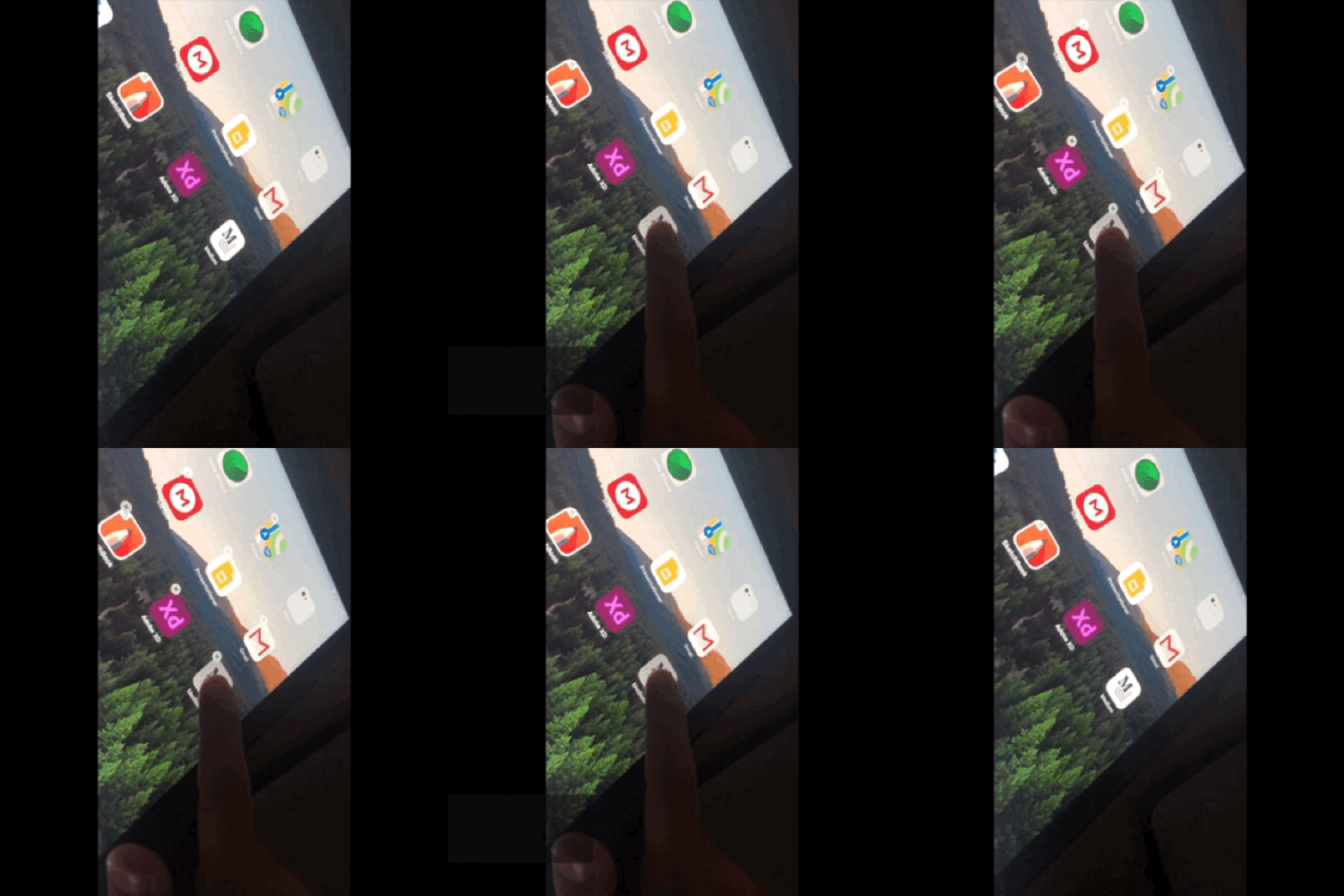
We were briefly introduced to interaction aesthetics last year, in this course we are getting more and more familiar with it. Last week, we formed groups and each group picked one pair of interaction attributes to work with. We picked Instant-Delayed. At first, it was difficult to come up with examples of delayed interactions, which I think is pretty normal since the majority of interactions nowadays are instant, meaning the product reacts and shows some kind of a feedback, instantly after the user’s action – if not simultaneously. We also thought about some non-technological/electrical examples, but the options were still limited, because, as mentioned briefly by Djajadiningrat et al. (2007), “… the link between action and reaction in mechanical devices(i.e. a pair of scissors) seem ‘natural’ …”, “the coupling is perceived as natural when there is no delay, when action and reaction are co-located, share the same direction, and have the same dynamics.”[1]
In some of the cases we found the interaction feedback was delayed due to the deficiency of the product, and it being not fast enough! Like turning on a light switch and the lamp taking a few seconds to light up. This delay can also show the “loading” of the information or internal parts of a device, which is still a type of a delayed interaction. We were also encountered with some examples that were intentional delays. This kind of a delay was more close to what our teacher intended, and what we saw in “Exploring Relationships Between Interaction Attributes and Experience” by Lenz et al. (2013).[2] In this paper, delay is connected to an interaction being worthy of attention, and not a malfunction, so it is intentional, “It creates awareness of what is going on.”[2] and wants to bring awareness to the task the user is doing. We then watched the videos of each group and discussed them. One thing that became apparent to me was the fact that these attributes in some cases overlap each other, e.g. instant and fast or inconstant and covered.
Something we did in class that was quite interesting to me was that we tried to match different attributes that are not in the same pair, this made us think about different examples and it could be useful when comparing two attributes that are similar to each other. e.g. gentle-powerful and slow-fast. These two pairs are so alike that in practice, we wouldn’t be able to distinguish between them. We thought of “painting a wall”, which is slow but powerful. With such an example I realized how different ‘fast’ and ‘powerful’ are. But is there an interaction or any act at all gentle but fast?
References:
[1] Djajadiningrat, T., Matthews, B., & Stienstra, M. (2007). Easy doesn’t do it: skill and expression in tangible aesthetics. Personal and Ubiquitous Computing, 11(8), 657-676.
[2] Lenz, E., Diefenbach, S., & Hassenzahl, M. (2013). Exploring relationships between interaction attributes and experience. In Proceedings of the 6th international conference on designing pleasurable products and interfaces (pp. 126-135).
 My Design Journal