second sketch (1)
Today we had a concept and plan in mind we wanted to follow, we then decided to have 2 groups of 4(from our classmates) to interview. The idea was to ask the first group, individually, to imagine they are being pursued/followed by someone, and have them name and explain the types of emotions they would go through, and the second group to show them the light pattern we had coded, and see if they are going to be able to recognize the intended emotion(s). The second “experiment” was also going to reveal the other emotions that might be expressed by the same pattern we had.
The light pattern gets triggered with a button that represents the part of the scenario that the person realizes they are being pursued. It represents the heartbeat and stress as an emotion they go through. The movement represented in the light patterns might not be actually the movement itself, but the speed or tempo of the heartbeat in that very situation, or tempo the person is breathing, the intensity of inhaling or exhaling.
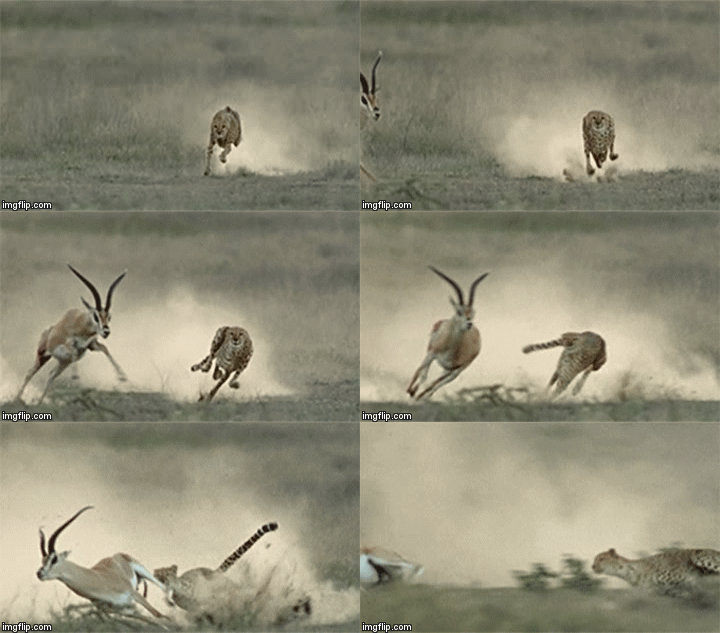
Something we realized was that in such scenario, if the person being pursued is running away without looking back has more confidence level, or if they keep looking back to estimate the distance and how fast/slow they should keep on escaping. I think looking back while running slows the person down, while the estimation might get more accurate, but they have slowed themselves down. If we look at animals and how they run away, they never look back.
We started with asking questions from 2 pairs of people in the class and both of the groups expressed somewhat the same emotions, with some exceptions. The second group mentioned a feeling of paranoia, which was surprising. Because up until that point, me and my teammate considered that the course of events starts with the escaper realizing they are being chased, with a level of certainty. The paranoia aspect of the situation could be related to more specific situations like a thief-victim chase. Another point was made regarding the emotion of calculating and evaluating the situation when you are running away and are close to a “safe spot” e.g. your home, and want to calculate how fast you should run to outrun the person, etc.
We then decided to have a brief coaching session with Jens, who advised us to not base our design decisions on the opinions of our classmates in this stage of the process. Which is interesting to me because last year, we had to do a number of projects interviewing, user testing, etc. but then when I thought about it more, I realized now we are in the sketch-making part of the design process. Jens encouraged us to try to “read” more and better our own sketches and try to be more and more honest with ourselves and have good judgement, and tweaking the code and also the sketch one time after another, to get more and more closer to the “goal” or the output we want to achieve. Another thing about asking around is that the opinions could potentially be very subjective and/or biased. And he said that the patterns should strive to be as iconic as possible, meaning that they should be universal, something that almost everybody could relate to, like the breathing light pattern of the mac Book. We need to have something that will show the intended story behind it, something that whoever is seeing it would get what it is.
Another thing we realized was that the “peak” part of the wave, was not something that remains or could remain for a period of time, the peak, which is the “heart drop” or the “heart skipping a beat”, should be represented as a sudden increase in the wave that lasts an instant, and then continues to get better over time.
So overall, we need to switch to experimenting with the light and the code itself, interpreting it, rather than going over and over the abstract matters. We need to get more into detail and “get our hands dirty”.
 My Design Journal