_________________________________________________________________
Second sketch (3)
For the “running” pattern, we started to think about the wave of a heartbeat. We discussed our own thoughts and experiences about it and concluded that when we have run for a long time, we can feel our heartbeat, but it is not a double-peaked one. When the heart beats fast, we only feel one peak and not two. So we thought of implementing that in the pattern.
For the calm stage, we went back and forth changing the numbers in the code and tried to “read” the light pattern and choose whatever feels the closest to when we are breathing normally during the day, the kind that you are usually not aware of.
We started to specify the ranges for the distance measuring sensor, i.e. where each light pattern should get triggered and be shown. For this, we decided to “role play” ourselves, my teammate being in a static mode representing the light, and me the moving person. We tried to feel figure out the feelings in each distance. It is apparent that in a person-to-person situation, the environment, which direction each person is facing, the existence of eye-contact, the culture each person grew up in and the kind of personality, play big roles in this. This experiment yielded some measurements that we later are going to implement in the code, for example, it started to get uncomfortable somewhere between 193-185 cm.
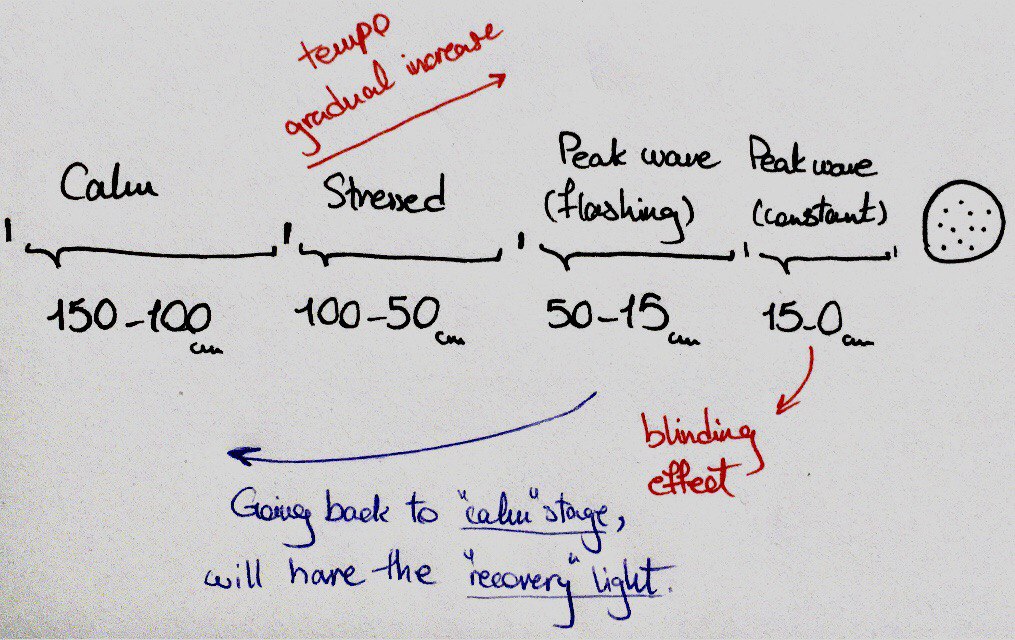
Although we drew a little sketch of the measurements with exact points and ranges, we are pretty sure we have to have a gradient effect in connecting the patterns with the distance, i.e. in an individual stage, the speed and/or the brightness of the patterns have to increase/decrease gradually. This is important to consider also in the transitions between two consecutive stages. The transitions have to be fluid and not stepwise.
Constraint: we had to compromise our experiment on the distance because if not, the sensor will pick up on the values that we do not want, and the light pattern will get jittery.
Other than the constraint part of it, we also thought of the fact that we looked at the distances in the context of human-to-human scales, and not human-to-object(a small object). which could be another reason for us to scale down the measures and the distances. Since the light is, metaphorically speaking, expressing its own emotions, we should look at the measures from its eyes, i.e. what distance is close/far from something as small as a LED’s perspective.
We are planning on testing the light and its reflection on a metal paper and a hard, dense foam and see what medium could make sense in relation to our concept. The reason for that is because we noticed some kinds of variety of materials used in the “external” part of the prototypes. We have been busy working with the technical part of everything like code, and circuits, so we decided it’s time to explore that area, too. This decision was made even with the knowledge of not having enough time for finishing the prototype in a way we have planned for it to be and work.
I had a discussion with one of my classmates about following the teachers’ suggestions. During our conversation I started reflecting on myself and my approach regarding the matter and I realized I am very meticulous with doing everything the teaches say I should do. Of course, the teachers are there to guide and help us in the right direction, however, sometimes, it might happen that what I have in mind as a design idea is pretty complex, but the teacher is not seeing the complexity of it. which I think is could be also connected to the “critiquing” concept. I tend to second-guess myself a lot and, although, it could be beneficial sometimes, but a lot of the times I should stick to my idea and believe in it. it has been proven to me that changing the direction completely after a critique session, is not the best strategy.
One of the struggles was the management of time in regard to knowing how much time (roughly) every idea or nuance is going to take, time being a constraint. The layers in each idea are plenty, and it is possible to dig as deep in each of them as one could. However, me and my teammate spent too much time in the “exploring nuances” in one single concept, which led us to having less than a week to test the options we had for sensors and mediums.
Another mistake we made was that we were too reliant on the graphical waves and curves, instead of “reading” the light patterns.
We dedicated the last day of the module mostly to experimenting with different stuff to see the reflections and see if we manage to magnify the brightness of the high power led even more. We used a couple of pieces of mirrors to create illusions.
Final feedback
We were not able to show our design due to technical difficulties and malfunction of the sensor and the high-powered LED; however, we managed to get some feedback that helped us to later reflect on our design process and decisions. One thing we realized was about sticking too long to an idea or a component in the design, despite it not working. In our case, we latched on to the high-powered LED for too long because, with it, we were able to have the repelling/blinding effect, which was not possible to achieve with a regular single LED. As a result, we thought we had to fix the technical issues in some way or another until the last minute, tried to get help from one of the teachers multiple times, but it just did not work. I strongly believe we had to be guided towards another direction after the technical issues. Where/when should we draw the line? When is the right time to abandon and give up on an idea/component?
 My Design Journal