Module 3. KICK-OFF
Today was the start of the third module. I am already thinking about mistakes I made in the last two, and also what the best possible strategies could be for us to explore the material and the concept to the fullest, and have some final prototype at the end.
We will explore and experiment with different movements to read and listen to how they feel in the body and also in the mind (which might be tied with how the outside world sees it). I have been wondering about whether the “feelings” will be arbitrary and subjective or not. It is clear that certain movements might have different meanings in every culture and society, some may even differ from person to person, in contrasting personalities. This is an interesting and important point to consider and think about while experimenting. It is important to consider, because KI (kinesthetic interaction), as was said in the kick-off lecture today, has a more public and social quality to it that invites others in by getting their attention, as opposed to the “regular” hands-on-keyboard interaction that is more private and attracts less attention. These two types of movements are mentioned in the paper “Kinesthetic Interaction – Revealing the Bodily Potential in Interaction Design” as “gross motor skills” and “fine motor skills” which respectively mean the movements that engage all or a portion of the body parts, (as opposed to) small and minor movements in the smaller muscles like fingers and eyes.[1]
Even a small change in our every-day, “normal” movements would make a difference in how we would feel about it during the movement and also afterwards. The change might be so small that would not even be noticeable by the public. But it is the “all eyes are on me now” feeling that causes that shift in the feeling. Thinking of this reminded me of something I read years ago about boosting your confidence. It said to do to-some-extent silly, abnormal behavior in public e.g. dance, point at something in an obvious way or sing aloud; I have done it a number of times and it does feel liberating. Breaking the norm and not be worried about what would others think, feels great. There could be another view on this matter that is opposing in the essence of it, and that is: these gross movements that attract attention could be coupled with embarrassment and shame if done unintentionally. Whereas, in my case, when done with one’s own decision, this element of shame will be a lot less. This might be something to look into or think about when exploring different movements.
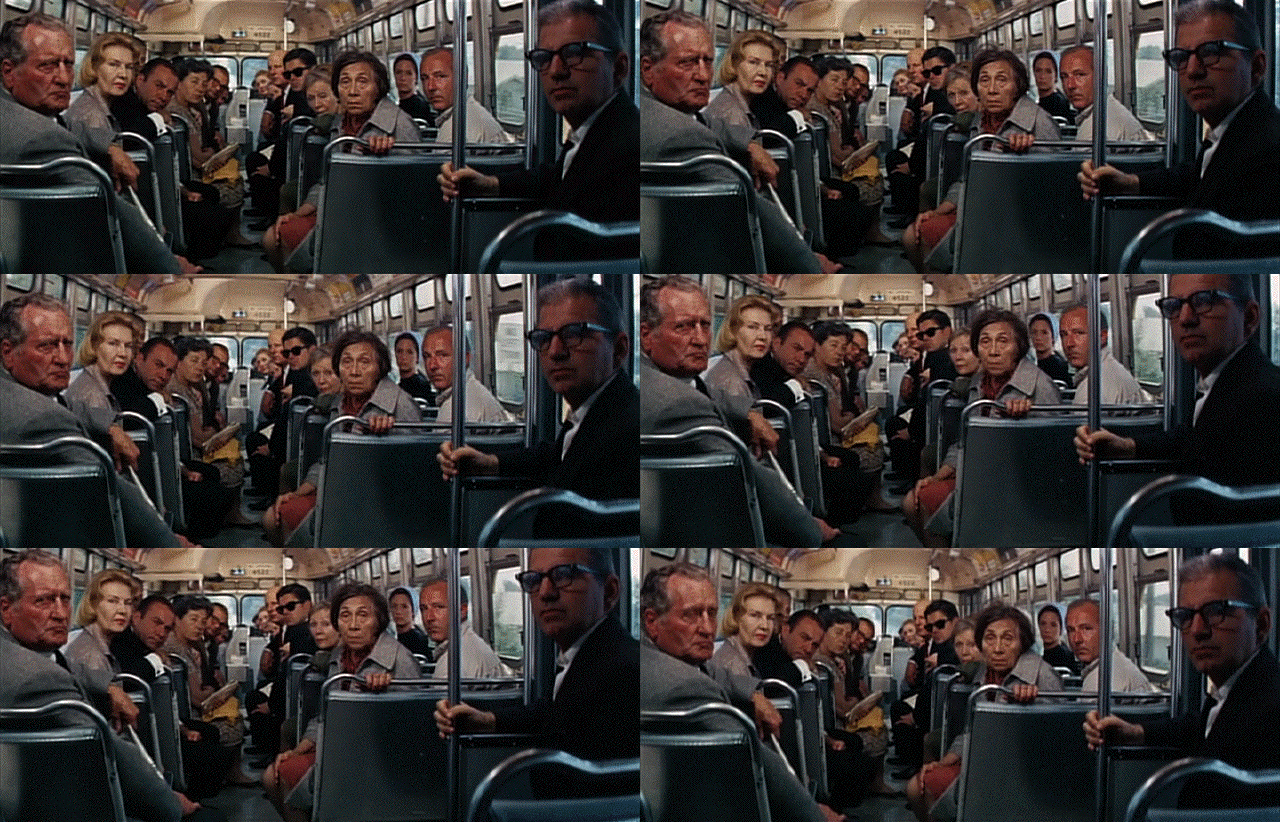
This brings me to another question: whether or not we have to think about and consider the environment the movement is being done in. I think the feeling one has after moving in a particular way is dependent on all these different factors, and we cannot separate the bodily feeling from what we experience mentally. On the other hand, I think the condition of the environment and where the movement takes place has an impact on the mental/psychological part of the experience. So they all go hand in hand, even if not connected directly.
In this course, though, we are focusing more on the individual bodily feeling and not so much on the social aspects of movements. (although, for some movements the social aspect might mix in with the other aspects inevitably.)
References:
[1] Fogtmann, M. H., Fritsch, J., & Kortbek, K. J. (2008). Kinesthetic Interaction – Revealing the Bodily Potential in Interaction Design. In Proceedings of the 20th Australasian conference on computer-human interaction: designing for habitus and habitat.
 My Design Journal