Experimenting with different movements – “Bodystorming”
We had a lecture about and revolving around the article “Studies of Dancers: Moving from Experience to Interaction Design”[1]. It talks about a lot of things among which a few are not interesting to us in the context of this course, but one of the things I found interesting is about how we could sketch a movement. How do we explore movements? The article gives examples and describes the studies they have done, suggesting a few methods that could work as a framework for us to be able to explore different types of movements in a more systematic way. Another interesting point the paper makes is about separating the three main perspectives i.e. what the mover sees(feels), the view of the machine(/camera) and the perspective of an (external) observer (shown in image below). (The overlapping between the “mover” and the “observer” is due to the fact that I think an observer could affect the “mood” of the mover, if the mover is aware of their presence and can see them. On the other hand, the mover can also affect the observer in many ways e.g. in performing arts.) This approach helps us to better evaluate and analyze our ideas in the different perspectives, which makes it even easier to “troubleshoot” and find the root cause more precisely, when something we think is not working.
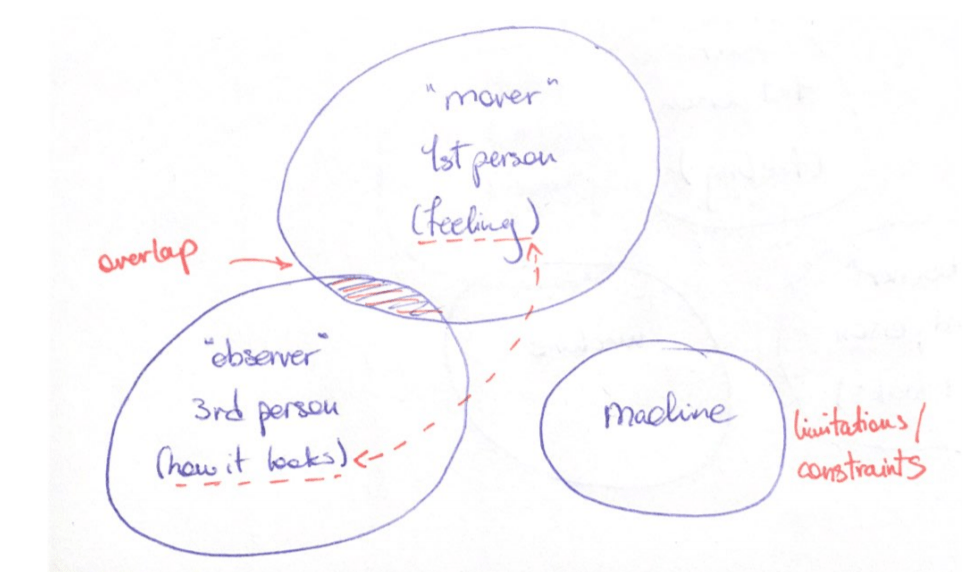
A lot of inspirations were taken from reading this paper for me, for example blindfolding ourselves, or closing our eyes when trying to experience the in-body feelings when moving about, which makes it easier to be and stay connected to our body and helps to avoid any (visual) distractions around us. Another benefit the “framework” has is the fact that it is easier to explain what you mean more concretely to your teammate.
A concept that was introduced to us in the lecture was “bodystorming”. Deriving from the famous brainstorming word, it is about generating ideas related to physical, motion-based concepts. Our teacher argued that we cannot sit down and think of movement ideas without actually moving about. It is hard to imagine how movements feel when we are not trying to feel them. The state of the body affects the “brainstorming”, let alone a bodystorming.
Some points I gathered from our first coaching: -Kinesthetic experience is not about the mechanical view of the body. -Be mindful of the differences between a “big idea” and its concrete, practical implications. -Poses can also establish feelings, but using them in this context could get tricky and the reason for that is that it could easily become a sort of a language, moving away from “body in motion” and the interactivity of the experience. -It is not about object recognition and whether the person is in that pose or not; we have to design movements, not picking existing ones. Of course if the poses are “designed” in a way that they would use a lot of the muscles in the body, bringing our attention towards the bodily feelings, it might be something interesting.
A pose could be more associated with staying in and keeping a gesture, and the word itself reminds me of known-by-all gestures that are universally/culturally famous, whereas a movement sounds more broad and it has that “moving” quality to it. They are both interesting to look into, but with poses, I, personally, think that there could be meanings/feelings coupled with them already, which makes it less interesting for us in this module.
We tried out some examples we came up with “bowing down” and “hands up”*, and in the middle of bowing down I remembered a movement from my yoga class. We then both started to do the pose to then feel the feelings. (The key is to lightly wiggle your upper body, either with each hand locked into the other hand’s elbow like in the image below, or free hands.) We interestingly felt heavy and light, locked in the ground but swinging and being free at the same time, the paradox was interesting to us.
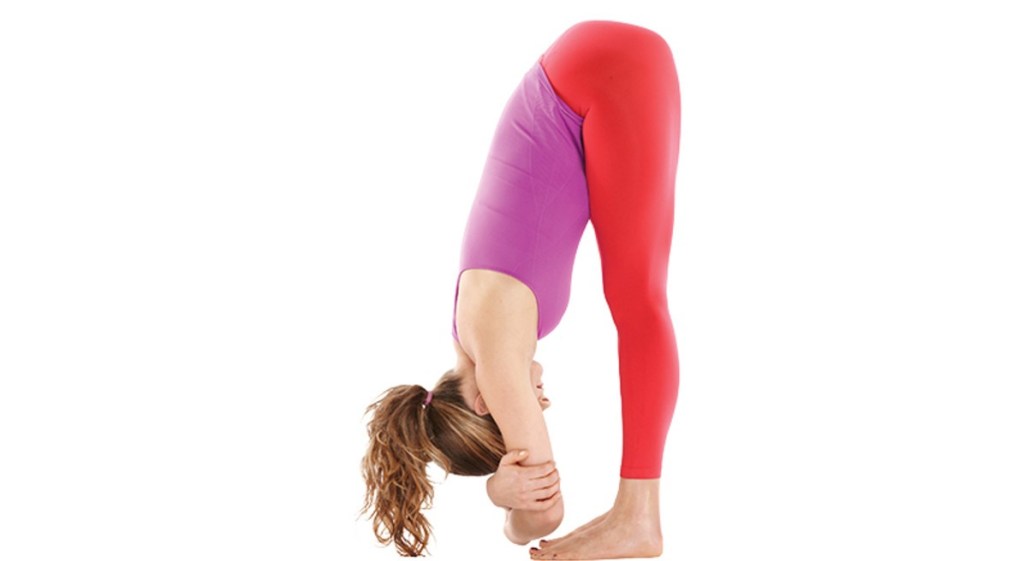
Something I noticed was that in this pose, we would not be able to see the screen, which takes away the possibility of having a visual-based output.
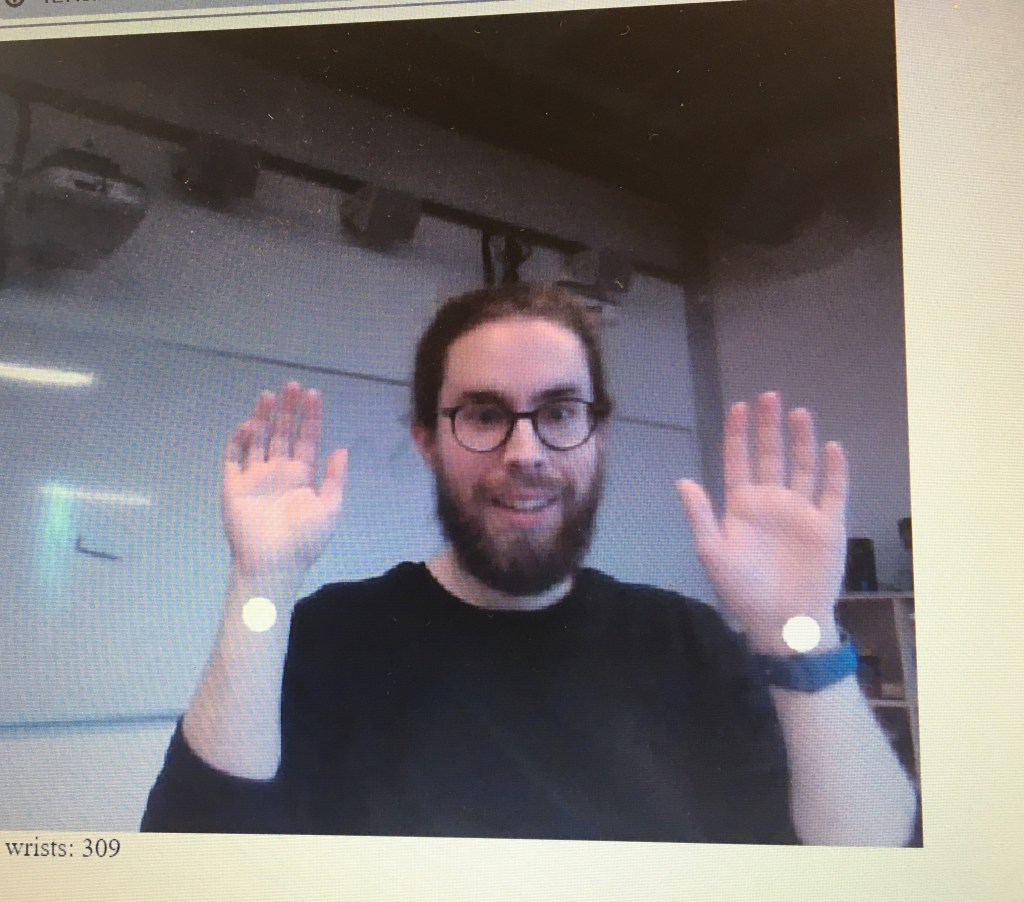
*The “hands up” experiment came to us after seeing the “wrist distance” sketch we were given. The showing the hands and palms reminded us of the feeling of surrender, which in a more conceptual level, could be associated with showing the other person you have no means of violence or threat for them.
References:
[1] Loke, L., & Robertson, T. (2010). Studies of Dancers: Moving from Experience to Interaction Design. International Journal of Design.
 My Design Journal