Frist sketch
We decided to tweak the existing sketch we had and came up with the “stretch ball” example to feel the movements as well as to try something out and have something simple up and running from the coding perspective and see how it looks on the monitor and if the 2d quality of the ML is going to pick up on the movements. The stretch ball has as its diameter the distance between the two wrist, so the more the stretch the bigger the ball.
We made use of some of the points that were made in the lecture about bodystroming in combination with the points we gathered from reading the paper itself. We tested different variations of the same movement, documented the qualitative data and then tried to add some kind of nuance to it with combining a few of the parameters (speed, rhythm); i.e. doing the stretch in a stepwise manner, fast or slowly, etc. (shown in the video below) Came up with the “curtain” example* that also has different variations depending on how much the concept of it makes sense(or not). We still do not know how we would be able to implement it in the code (it seems pretty difficult), but I am going to try it at least. Which brings me to the fact that no matter how grand of an idea you might have, you must be able to execute it, and in our case, coding is not our strongest skill.
We decided to use the framework mentioned in the article “Studies of Dancers: Moving from Experience to Interaction Design” that separates the qualities of a movement into two categories “image-based” and “mechanically-based”.[1] We tweaked the framework a little bit, instead of viewing and paying attention to the mechanical qualities, we “listened” to the “bodily feelings”. If the stretch is done in a stepwise manner, the feelings associated with it are different. It reminded us of when we want to show someone the size of something or scaling it, and a bit robotic. It has an informative quality and feeling to it. Whereas, when the stretch is done fluently and fast is feels more like an intense workout. In a normal speed it feels like an invitation for a hug and opening up yourself to something or someone. We imposed a constraint on ourselves and that was to have our eyes closed when we wanted to feel the bodily feelings in all the variations of the stretch. And it did help, of course, to stay more focused.
From the previous two modules, I think I have a bit of an idea of what we should NOT do in order to 1)explore the material and the concept as much as possible, 2)have a prototype at the end of the module. Keeping the balance between the different stages of the process in a timely manner has been one of my biggest challenges in this course. There cannot be clear-cut lines between the stages and the whole process is not a linear one, but rather a set of cycles, maybe like a spiral that represents the iterations done on the same process with minor changes. Iterations are needed for sure; however, I think we should consider our deadline, too. Specially because we are not familiar with the material, an excessive portion of our time in all of the three weeks has been spent on figuring out the code, or making it work. A lot of us, including me, do not have any considerable amount of experience in programming. Maybe I have to attend an extra course on coding.
The stretch ball sketch has some issues one of them is the fact that if we keep stretching beyond our body’s normal capacity, the arms go behind our backs making the wrists’ distance less, so the ball gets smaller instead of getting bigger, this is an issue that derives from the 2d character of our design tool. Now we know the “the more the stretch, the bigger the ball” cannot happen with this sketch. It actually has the exact opposite effect i.e. when the arms are in the maximum amount of pressure, the ball is not in its maximum size.(this is visible in the 8th second of the first video in this post, and also in the sketch below.)
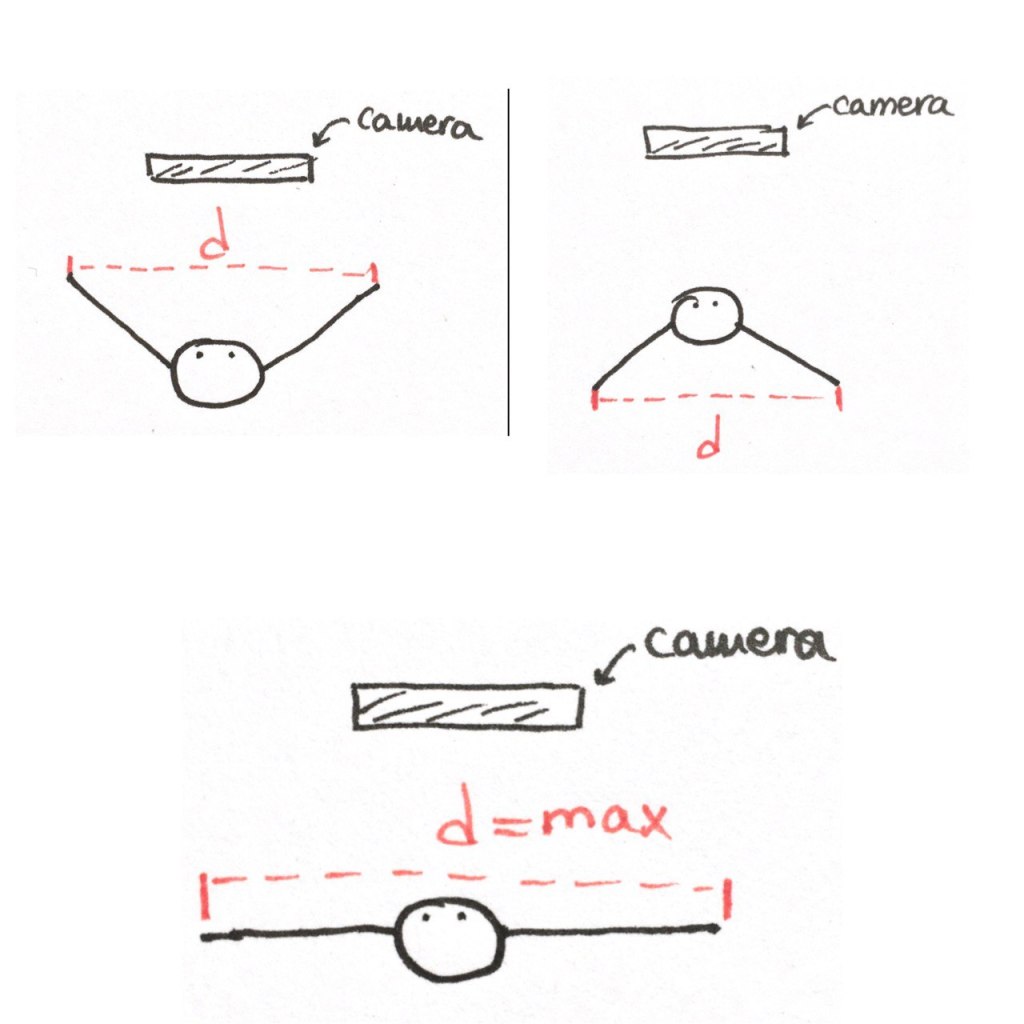
Is there a way to fix this in the code? Or should we move on from this sketch? From this sketch and movement I can go to another kind of movement similar to this that also has “stretching” as its main quality. But I think stretching is very basic as a movement for us to stick with longer than this, we stretch when we want to start exercising or when we are tired. The movements itself, even if done in a larger scale of the body, does not seem to have any more interesting points for us uncover or explore. Now the question is whether or not I have exploited the concept fully enough or not?
_________________________________________________________
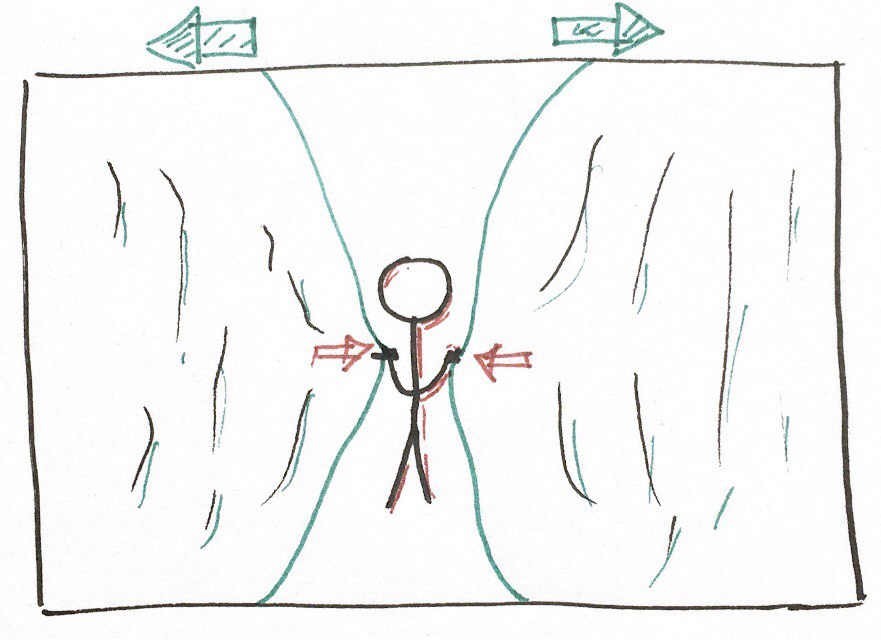
“curtain” example* : This idea came to me after we realized the stretch ball sketch was too easy and when the ball is large, the person cannot see herself in the monitor anymore which can be a discouraging factor for the mover to do the stretch. On top of that, I wanted to implement some kind of a story to the interaction with this idea, some sort of an elevation. I need to ask myself though, does this “elevation” add more complexity to the visual/graphical part of the whole interaction, or is it adding any nuance? Because sometimes adding features is equivalent to unnecessary complexity, something that does not add value to the quality of the interaction, only to its quantity.
The idea is about stretching or moving your arms for a purpose. In the first version of the sketch (a), the person is shy and private so they want to close the curtains, but the curtains (the interface) wants to open them to challenge the person to be more open. This idea would work initially with the position of the wrists.
The second version(b) is the opposite, meaning the curtains want to close but the person wants to keep them open.
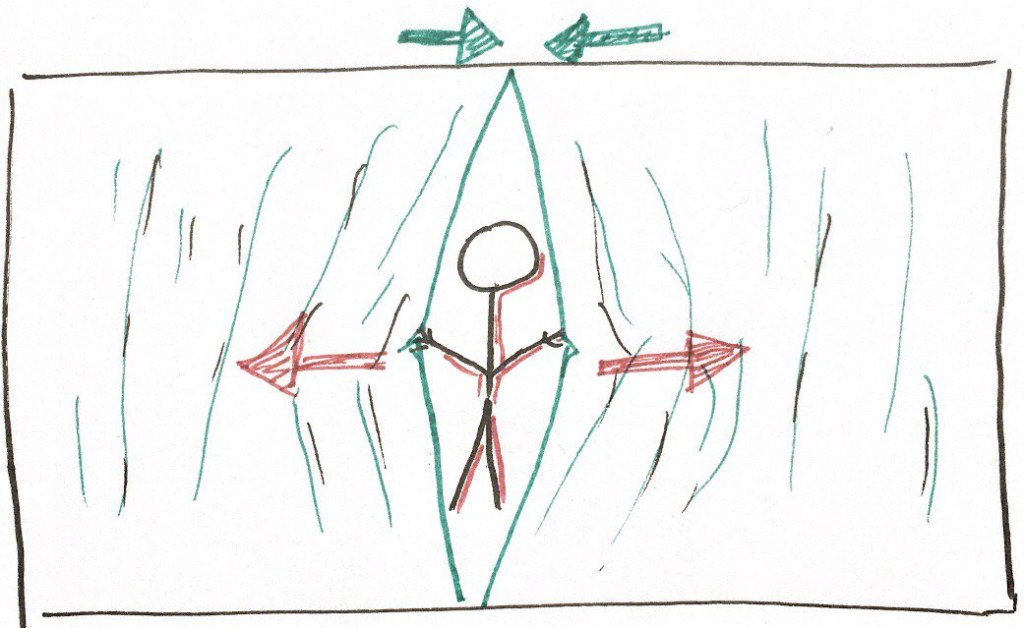
We did not end up using these sketches (a) and (b) due to probable complexity of code.
References:
[1] Loke, L., & Robertson, T. (2010). Studies of Dancers: Moving from Experience to Interaction Design. International Journal of Design.
 My Design Journal