Adding Smell to a game!
Me and my teammates started the brainstorming process of choosing a game to add a smell to one of its “game mechanics”. Since we are working remotely at the moment, we decided to use whatever scent/smell we have at home. We have landed on the game “draw the pig tail” which is a party game, we want to add a smell to this game for the player to use to get to the right position of the tail. In the original game, the player has to be blindfolded and has to spin around for a couple of times, and then try to, first, find the picture of the pig, and then place the tail on the right spot. We are thinking about adding a not-so-pleasant smell, just to make it funny and for it to make sense. Sniffing a pig’s “behind” where the tail is, would not smell like flowers! Something I found in home that does not have a nice smell, is apple cider vinegar. Using such a smell, would add a paradox to the whole game, i.e. bad smells normally repel us, whereas nice smells attract us. In this game, though, the player is “forced” to tolerate the bad smell and has to “look for it” to have a better chance at winning.
We had a discussion about how exactly we want the game to be, whether we want to be blindfolded or not, etc. After some thinking and talking, we decided to be blindfolded, because if not, a lot of effort should have been made to not “give away” the answers to the player. We thought of some ways to solve this problem, but then we realized it was too much work for such a short amount of time we had. Being blindfolded and trying to smell something without seeing anything is also pretty funny-looking and we thought it would make the whole experience more fun to play and to watch, plus, it would save us the problem of stains and/or colors being caused by the ingredients we were going to use. We decided to have more body parts and not just the tail, which meant using more smells in the game. This brings more “problems” we needed to take care of; e.g. picking smells that would not get confused for the other ones, they have to have similar levels of intensities so that none of them would get overpowered by the other smells, etc. We took away the “dizziness” of the original game. Now the game provides hints and cues for the player to have a chance in winning by using their sense of smell. So, the player is required to have a moderately-working olfactory system to be able to play and potentially succeed in this game. When watching the testing videos we recorded of ourselves at home playing the game, we noticed we were inevitably using our hands (sense of touch) to get to the right area where the picture or the post-it notes were located.
As far as the preparations and the set-up of the game for our experimenting, we decided to use whatever we have at home, since we are working remotely. I used ‘apple cider vinegar’, ‘rose water’ and ‘balsamic vinegar’. These are scents that are pretty strong and easy to distinguish. They were respectively for the pig’s ‘tail’, ‘eyes & nose’ and ‘legs’.
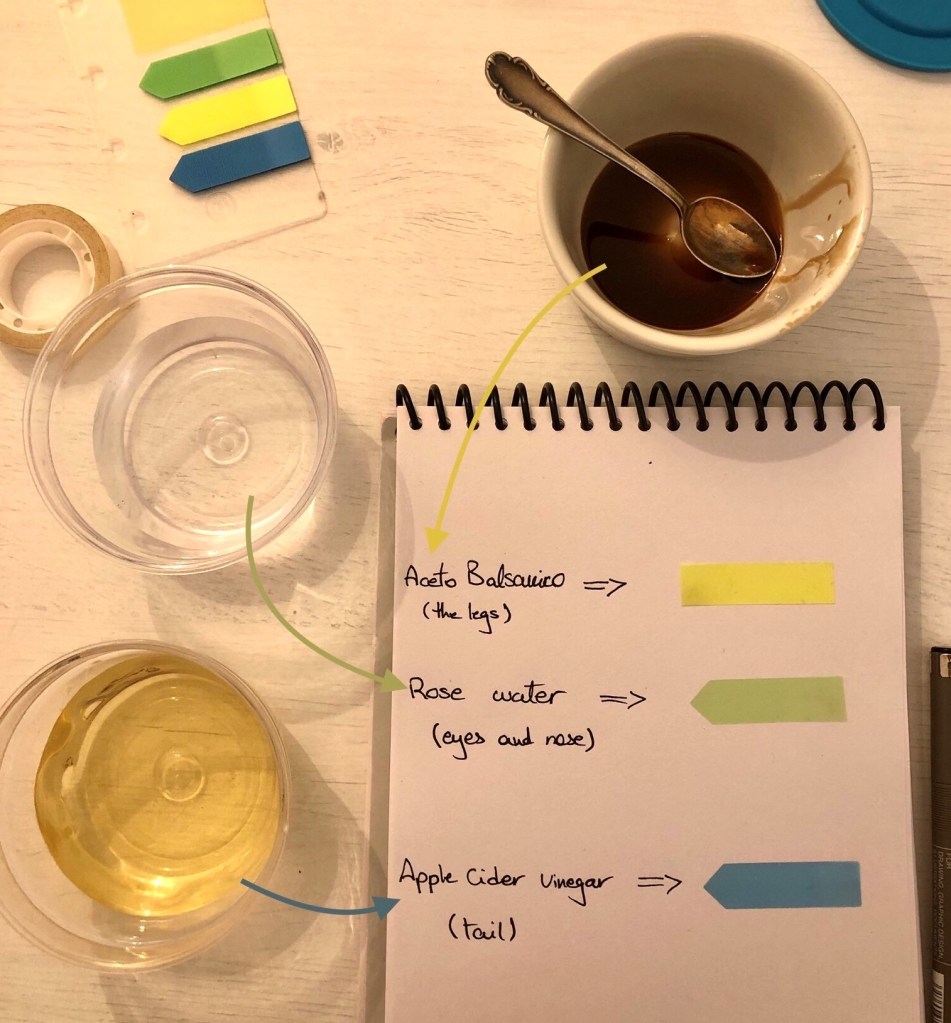
*Note: I ended up switching to regular sticky notes with the body parts drawn on them (instead of using different colors), for the sake of the video prototype, for more clarity for the audience, and to be in sync with my groupmates’ work.
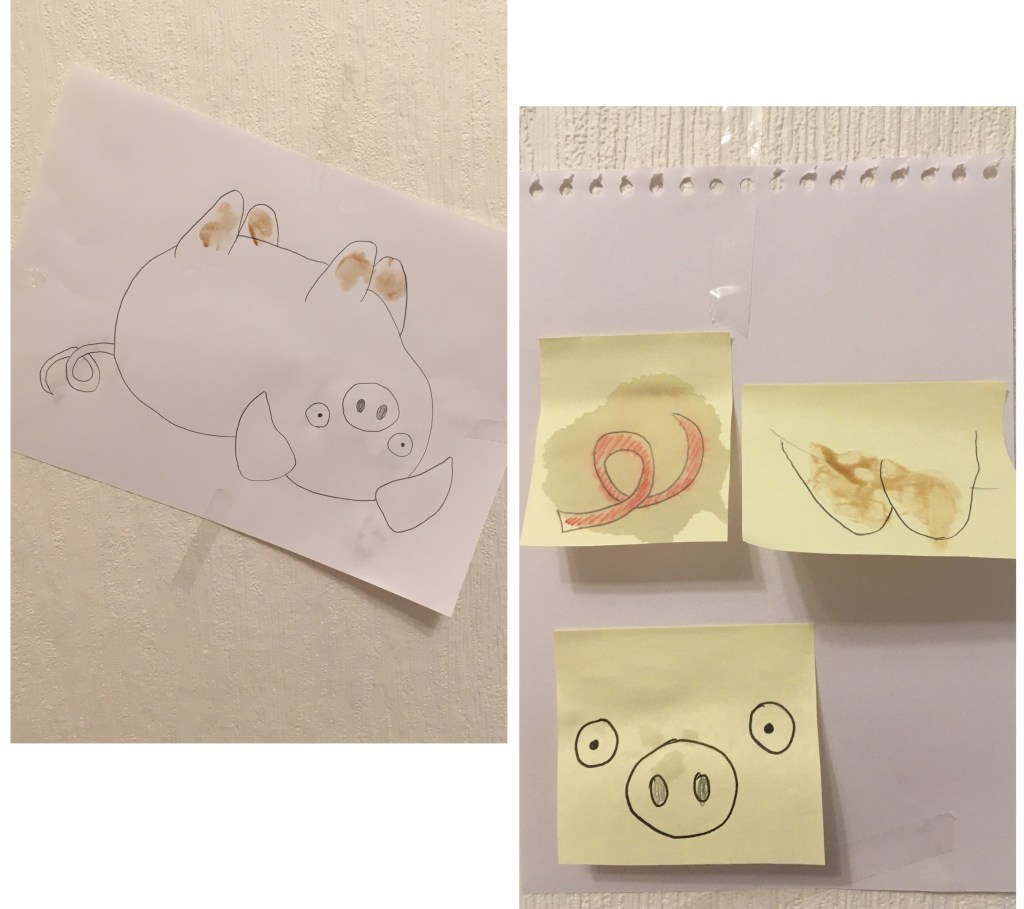
I asked my sister to put the picture of the pig wherever on the wall, and however she likes, that is why the picture is upside-down and tilted. Since I drew the picture myself, this way, I wanted to avoid my photographic memory to help me in the game, and use my sense of smell as much as possible. Another interesting point was that in the middle of the game, I came across one of the points stated in the paper by Niedenthal (2012) named ‘Adaptation or habituation’: “…our tendency to become unaware of odors to which we have been exposed over time…”[1]; so I had to stop for a few seconds to “refresh” my olfactory system. (this is also shown in the final video prototype.)
We were first thinking about having a bigger canvas to have the pig on, like a white board, but some of us did not own white boards at home so we had to be more creative. I decided to use a big piece of cardboard, tried to put it up on the wall but could not succeed. So I decided to stick with a few pieces of paper and some post-it notes. This makes the game itself more family-friendly, since it uses equipment and smells that are available in every household.
Final Feedback
The feedbacks were all positive. Some of the points that were mentioned included the differences between the way we did the tests, and having the same game at a party with a lot of people as spectators that would most probably cheer the player, or laugh at them, etc. all these would change the dynamic of the game and how the person would perform, and overall, the whole experience.
References:
[1] Niedenthal, S. (2012). The Skin Games: Fragrant Play, Scented Media and the Stench of Digital Games. In Eludamos. Journal for Computer Game Culture, 6(1).
 My Design Journal